Flip the Switch: The Layered Lighting Secret That Makes Every Room Look Expensive
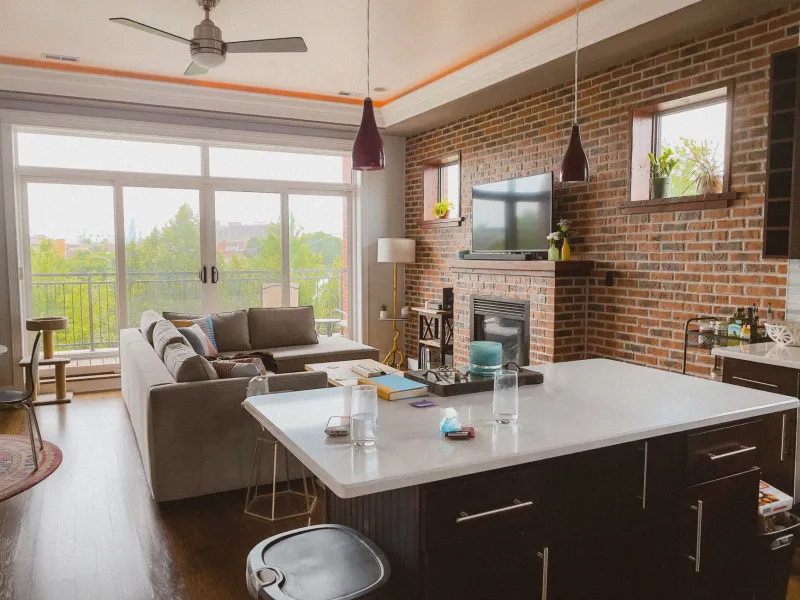
I'll never forget the moment my friend Dana texted me a photo of her freshly repainted living room, captioned: "Spent my whole Saturday on this. Still looks like a dentist's office."
She wasn't wrong. The paint was a gorgeous warm greige, the furniture was fine, but that single, buzzing overhead flush-mount was flattening everything into a pale, institutional nothing. Her room didn't need a new color. It needed new light.
Here's the truth nobody at the paint counter tells you: lighting changes how a room feels more than any wall color ever will. The good news? Fixing it is often cheaper than a single can of premium paint.
Why Overhead-Only Lighting Fails Every Time
A single ceiling fixture casts light straight down, creating harsh shadows under eyes, under furniture, under every interesting texture in the room. Designers call it the "hotel lobby effect" — technically illuminated, emotionally cold.
Real rooms, the ones you sink into at the end of the day, are lit from multiple heights and directions. That's it. That's the whole secret.
The Three-Layer Lighting Rule
Professional designers build every room on three layers, and once you know them, you'll spot them everywhere — in magazine spreads, in that impossibly cozy restaurant you love, even in well-staged open houses.
Layer 1: Ambient. This is your general, room-filling light. It can be your overhead fixture — but ideally on a dimmer, and ideally not the only source.
Layer 2: Task. Focused light for doing things: a reading lamp beside the couch, under-cabinet strips in the kitchen, a bright sconce by the bathroom mirror.
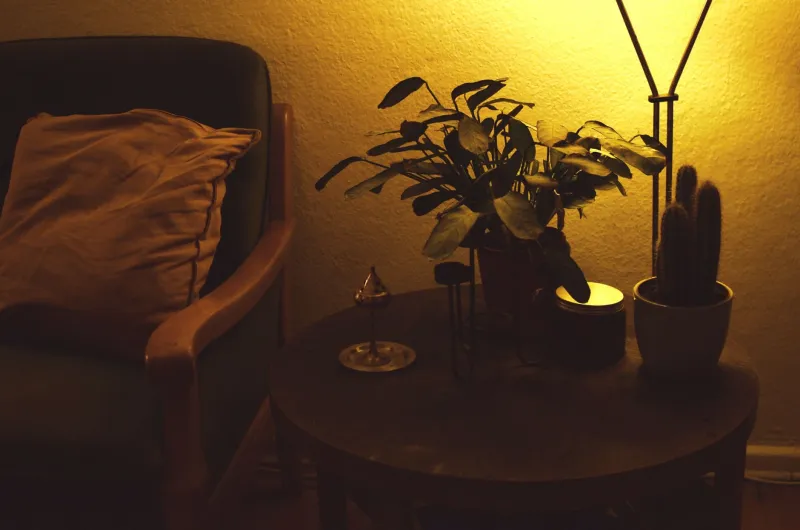
Layer 3: Accent. The mood layer. A small lamp glowing on a bookshelf, an uplight behind a plant, a candle on the coffee table. Accent light creates depth and shadows — the visual texture that makes a room feel finished.
A room with all three layers feels intentional. A room with only Layer 1 feels like a waiting room.
Bulb Shopping, Demystified
Walk down the bulb aisle at any Home Depot or Lowe's and you'll face a wall of numbers. Here's all you actually need to know:
- Color temperature is king. Look for the Kelvin number on the box. Anything labeled 2700K or 3000K is "warm white" — that cozy, golden glow. 4000K and up is cool, blue-white, and clinical. If your living room feels off and you can't figure out why, I'd bet money you've got 5000K "daylight" bulbs in there.
- Lumens, not watts. Watts measure energy, not brightness. For a cozy lamp, 450–800 lumens is plenty. For task lighting, go brighter.
- Buy dimmable bulbs, even if you don't have a dimmer yet. They're the same price, and it future-proofs you.
One more tip: mismatched color temperatures are the fastest way to make a room feel chaotic. If one lamp is 2700K and its neighbor is 4000K, your eye registers the clash even if your brain can't name it.
Three Real Rooms, Three Real Turnarounds
Dana's living room (Austin, TX): Total spend: $74. She swapped the 5000K overhead bulb for a 2700K dimmable one, added two secondhand table lamps with warm bulbs, and put a $12 plug-in dimmer on the floor lamp. Her text afterward: "It looks like a different house. I'm furious I bought paint."
The Hendersons' kitchen (Columbus, OH): Their problem was the opposite — too dim and too yellow in the corners. For about $90, they added peel-and-stick under-cabinet LED strips (task layer) and a small counter lamp near the coffee station (accent layer). The room finally works at 6 a.m. and 10 p.m.
Marcus's rental bedroom (Chicago, IL): No hardwired overhead at all — a common renter plight. Instead of living in the dark, he used two plug-in wall sconces and a trio of battery puck lights inside the closet. Total: $58, zero landlord problems, and the whole setup moves out with him.
Your Weekend Lighting Refresh Checklist
- Swap every cool-white bulb for 2700K warm white.
- Make sure each main room has light at three heights: ceiling, mid-level (table/floor lamps), and low (candles, small accent lamps).
- Add a dimmer — plug-in versions cost under $20 and require zero electrical work.
- Turn off the overhead after dark and live by lamplight for a week. Notice how quickly you stop missing it.
None of this requires a contractor, a permit, or even a toolbox beyond a screwdriver. It just requires letting go of the idea that a beautiful room starts at the paint store.
Sometimes the most fabulous thing you can do for your home is flip a different switch.