One Surface, One Glow, One Story: The Tiny-Foyer Edit That Beats a Built-In Remodel
Small foyers rarely fail because they're too small. They fail because we ask them to be a mudroom, a mailroom, a shoe closet, and a first impression all at once. The result is a pile of good intentions: a bench buried under bags, a hook that lost its hook, a lamp that never gets turned on.
After years of overthinking my own 4-by-6-foot entry, I landed on a quieter approach. Instead of adding more systems, I stripped the space down to three working parts. One landing surface. One light source. One personal anchor. That's it. No built-ins, no drywall dust, no permission slip from a landlord.
The Formula: Three Pieces, Three Jobs
Think of your entryway as a tiny stage. Every object needs a role, and no object gets to do two jobs badly.
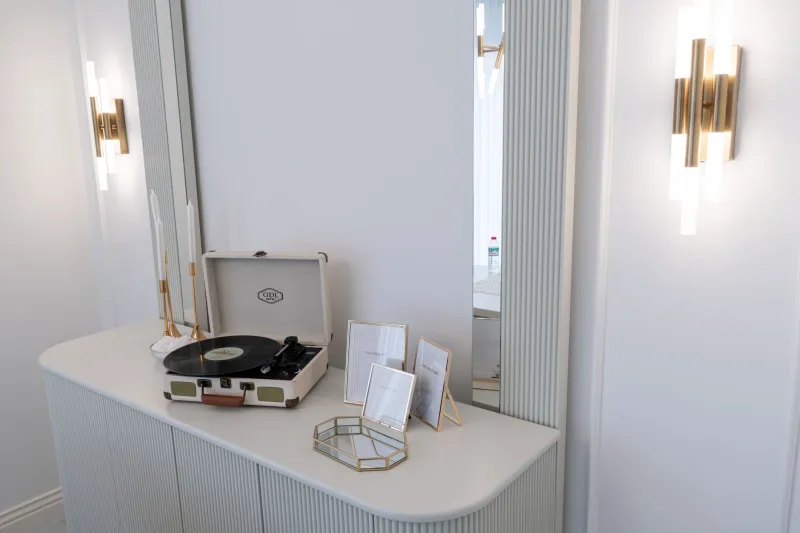
The landing surface catches what arrives with you: keys, mail, a coffee cup, a package. It can be a narrow console, a wall-mounted shelf, a sturdy thrifted stool, or even a slim floating drawer. The point isn't storage volume—it's a designated spot so clutter has somewhere to land besides the floor.
The light source does the emotional work. A small lamp, a plug-in sconce, or a rechargeable picture light makes a foyer feel like a room instead of a hallway. Overhead builders'-grade lighting flattens everything; a warm pool of light at eye level adds depth and a reason to slow down.
The personal anchor is the piece that makes the space yours. A framed photo from a favorite trip, a small painting, a mirror with a good story, a ceramic bowl you made in a Saturday workshop. It doesn't need to be expensive. It needs to be specific to you.
What about shoes, coats, and the dog leash? Those belong in a closed cabinet, a closet, or a nearby basket—not on display in a space this small. The three-piece formula is styling, not storage. Once you stop asking the entryway to hold everything, it can finally look like something.
The Tape Test: Try the Layout Before You Buy
Here's the trick I wish I'd known before my third return trip to Target. Grab painter's tape and mark the footprint of each piece on the floor and wall. A 30-inch console becomes a 30-inch tape rectangle. A wall sconce gets a tape square at the height you'd hang it.
Then live with it for 24 hours. Walk in with groceries. Open the front door in the dark. Kick off shoes. If the tape rectangle crowds your swing path or makes the door feel heavy, you've saved yourself a receipt and a Saturday.
A few tape-test rules I swear by:
- Leave at least 36 inches of clear walking path through the foyer.
- Keep the landing surface no deeper than 12 inches in a narrow hall.
- Hang the light so the bottom sits around shoulder height—low enough to flatter, high enough to avoid head bumps.
- Put the anchor where you see it from the front door, not where you see it from the coat closet.
A Renter-Friendly Shopping Plan
You don't need a contractor to pull this off. You need a measuring tape, a pencil, and a willingness to shop your own home first.
Landing surface: Look for a narrow console or wall shelf at IKEA, Target, or a local thrift store. A sturdy vintage stool works beautifully in a tight corner and costs less than a new flat-pack piece. Check Facebook Marketplace for "entry table" and "narrow console"—people sell them constantly when they move.
Light source: Plug-in wall sconces are the renter's secret weapon. No hardwiring, no electrician, and most mount with a couple of screws or adhesive strips. Rechargeable table lamps are another great option if you don't want a cord crossing the floor. Spend $30-$80 and put it on a smart plug so it clicks on at dusk.
Personal anchor: This is where thrift stores and estate sales shine. Frame a photo you already love in a $6 Goodwill frame. Hang a small mirror—it bounces light and makes the space feel twice as wide. Or lean a favorite print on the landing surface and skip the nail entirely.
My total spend on the last version: $42 for a thrifted console, $28 for a plug-in sconce, and $0 for a framed photo I'd been storing in a closet. The tape test took 20 minutes. The whole reset took an afternoon.
Before and After: Two Real-Life Versions
The apartment entry: Before, a leaning shoe rack, a pile of mail, and a bare bulb. After, a slim wall shelf at hip height, a rechargeable brass lamp, and a small framed postcard from a trip to Santa Fe. The shoes moved into a closed closet bin. The space reads calm instead of chaotic, and the lamp makes the hallway feel intentional at night.
The suburban front hall: Before, a bench buried under backpacks and a gallery wall that felt like a jigsaw puzzle. After, a narrow console with one drawer, a plug-in sconce above it, and a single large mirror as the anchor. The backpacks moved to a hook rack inside the coat closet. The gallery wall came down, and the room breathed.
The Real Win: Fewer Decisions
A beautiful entryway isn't about maximizing storage or copying a catalog. It's about reducing the number of decisions you make when you walk through the door. One place for keys. One warm light. One thing that makes you smile.
Start with tape. Shop your house. Buy slowly. And remember: the best small-foyer upgrade isn't a mudroom makeover—it's the confidence to leave things out.